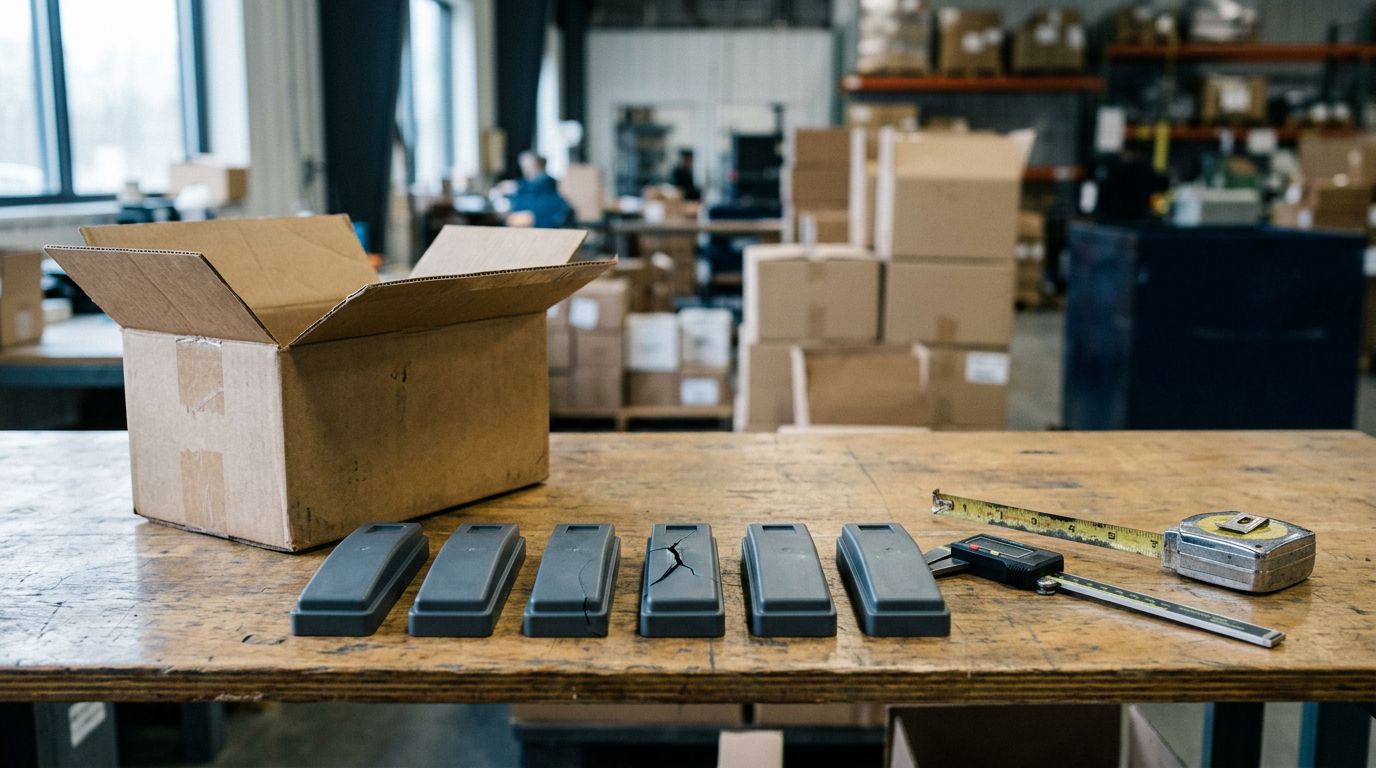
A foreign buyer facing a Chinese supplier's breach usually has three levers: insist on performance or repair, terminate and recover what was paid, and claim damages. Whether those rights turn into money depends less on the rule itself than on four practical facts: your paper trail, whether you gave notice in time, what your dispute clause says, and whether the supplier has assets in mainland China that a Chinese court can reach.
This guide is written for overseas importers, brand owners and procurement teams buying from manufacturers in mainland China. It assumes the contract is governed by PRC law or that PRC law will matter because enforcement will happen in China. If the contract is silent on governing law, see the note on the CISG below.
1. Start by naming the breach correctly
The remedy you can use, and how quickly you must act, depends on which kind of breach you are dealing with. Mixing them up in the first notice is one of the most common and most expensive mistakes.
The goods are coming, just late
You can demand performance and claim losses caused by the delay. Termination is generally available only after you demand performance within a reasonable period and the supplier still fails, or where the delay defeats the purpose of the contract, for example seasonal goods that miss the season (Civil Code Art. 563).
The goods arrived but do not conform
You may require repair, replacement, rework or return, or a price reduction, and claim further losses (Arts. 582–583). This right depends on a timely quality notice, discussed in section 4.
You paid a deposit and nothing shipped
You can terminate, recover the advance payment and claim damages. If the Chinese contract text calls the payment dingjin (定金, earnest money), a supplier who fails to perform must return double (Art. 587), but earnest money cannot exceed 20% of the contract price (Art. 586), and you must choose between earnest money and liquidated damages (Art. 588). A payment called a "deposit" in English is often just a prepayment (预付款) and does not carry the double-return rule.
The supplier stops answering
Before anything else, confirm which legal entity signed and whether it still exists in the same form. Trading names, group names and the company that actually received your money are often different.
2. What you can realistically recover
- Actual loss and lost profit, within foreseeability. Damages cover the loss caused by the breach, including profit you would have earned, but not more than the supplier foresaw or should have foreseen when signing (Civil Code Art. 584). The Supreme People's Court's 2023 interpretation sets out how courts calculate this: resale or production profit less reasonable costs, and, where you bought replacement goods, the price difference of that substitute transaction (SPC Interpretation, Arts. 60–63).
- Liquidated damages, but not always in full. An agreed damages or late-delivery clause is enforceable (Art. 585), yet a court or tribunal may reduce it on request if it is excessive. As a general rule, an amount exceeding the actual loss by more than 30% is treated as excessive, and the party seeking the reduction bears the burden of showing it (SPC Interpretation, Arts. 64–65). Treat your liquidated damages clause as leverage and a floor for negotiation, not as a guaranteed figure.
- Only losses you could not reasonably avoid. You cannot recover losses you failed to mitigate (Art. 591). If your line is idle, buying replacement goods at a documented, reasonable price usually protects the claim better than waiting.
- Withholding your own payment. Where your payment falls due after delivery, you may generally withhold it until the supplier performs (Art. 526). An unpaid balance is often the strongest leverage a buyer has, so do not release it to "keep the relationship going" without a written settlement.
3. Your dispute clause decides where you can get paid
A strong claim that cannot reach the supplier's assets is a weak claim. Most Chinese suppliers hold their assets, receivables and bank accounts in mainland China, so the question is which route turns a decision into a frozen account or a sale of assets there.
Most direct path to Chinese assets
A mainland judgment is enforced by the same court system, and property preservation (freezing bank accounts or other assets) is available before or during the lawsuit, usually against security. Since 1 January 2024, foreign parties may agree in writing on a Chinese court even if the dispute has no other connection to China (Civil Procedure Law Art. 277), and Chinese courts may also hear foreign-related cases with an "appropriate connection" to China (Art. 276) (summary of the 2023 amendments).
Neutral, enforceable, with asset freezing
For arbitration seated in mainland China, the amended Arbitration Law in force from 1 March 2026 recognises the parties' choice of seat and lets a party apply to court for asset preservation, including before the arbitration begins in urgent cases (Arts. 39, 58 and 81) (summary of the amendments). Hong Kong-seated arbitrations administered by qualifying institutions such as HKIAC can seek mainland interim measures under the 2019 Mainland–Hong Kong Arrangement.
Enforceable later, but no early freeze
An award from Singapore, London or another New York Convention seat can be recognised and enforced in China. The practical gap is timing: mainland courts generally do not grant interim asset preservation in support of arbitrations seated outside mainland China and Hong Kong, so a supplier may have months to move assets before you can act.
Often the slowest route to Chinese assets
A foreign court judgment must first be recognised in China. Chinese courts have become more open to this since 2022, but recognition remains case by case, and it can be refused on grounds such as lack of jurisdiction, defective service or conflict with a Chinese judgment (Civil Procedure Law Art. 300). If your contract points here, factor that extra step into your strategy and your settlement expectations.
If there is no dispute clause at all, for example because the deal ran on purchase orders and proforma invoices, a Chinese court will usually have jurisdiction as the court of the defendant's domicile or the place of performance. Read the supplier's order confirmation and terms: a clause buried there may still bind you.
4. Deadlines that quietly kill claims
- Quality notice. Notify defects within the inspection period in the contract. If none was agreed, notify within a reasonable time after you discovered, or should have discovered, the problem, and in any case within two years of receipt unless a longer quality guarantee period applies. Missing this window means the goods are treated as conforming (Civil Code Art. 621).
- Limitation period. Claims under an international sale of goods contract are time-barred four years after you knew or should have known of the breach (Art. 594), rather than the general three years (Art. 188). A written demand to the supplier generally interrupts the period; keep proof of delivery of every demand.
- Contractual deadlines. Termination notices, cure periods and notice-address clauses in your own contract are often shorter and stricter than the statute. Read them before you write.
- Documents from abroad. China joined the Apostille Convention with effect from 7 November 2023, so public documents such as a certificate of incorporation now generally need an apostille rather than consular legalisation. Private documents such as a power of attorney usually need notarisation first.
5. A 30-day action plan
Freeze the record
Collect the contract, POs, specifications, approved samples, inspection and test reports, payment records, logistics documents and all email and WeChat messages. Export chats with dates and sender identities rather than relying on screenshots, and commission an independent inspection if quality is in dispute.
Send a proper written notice
Identify the breach, list the defects, set a cure deadline, state the remedies you reserve and whether you are suspending payment. Send it to the contract's notice address and the registered address, with a Chinese version. Avoid informal concessions in chat.
Check the supplier and choose a route
Look up the company on the National Enterprise Credit Information Publicity System and search existing enforcement cases on the courts' enforcement information platform. Then decide: negotiate with leverage, terminate by written notice (effective on arrival, Civil Code Art. 565), buy replacement goods, or file with a preservation application.
6. When is legal action worth it?
Not every breach justifies litigation or arbitration. For a modest order, a firm notice, withheld balance payments, a platform claim such as trade assurance, or a trade credit insurance claim is often faster and cheaper than formal proceedings. A China lawyer adds the most value when the amount is significant, when the supplier has gone silent or appears to be moving assets, before you send a termination notice that cannot be withdrawn, and before you sign a settlement that releases claims.
The deciding question is rarely "am I right?" It is "which step gives me the most leverage today, without closing off the route that can actually reach the supplier's assets?"
Related service: Claims Against Suppliers: Demand Letters, Arbitration & Litigation ↗
A supplier dispute is often won or lost on the first notice.
If a Chinese supplier has missed a delivery, shipped defective goods or kept your deposit, we can review the contract, the dispute clause and the supplier's profile, and set out realistic options before you commit to a route.
Related Reading
- Signing a Contract with a Chinese Company: The Clauses That Decide Whether You Can Enforce It
- A Chinese Company Owes You Money: How to Collect a Debt in China
- Enforcing a Foreign Judgment or Arbitral Award in China: What Works in 2026
This article is general information about PRC law as of 28 September 2026 and does not constitute legal advice on any particular contract or dispute. Remedies, deadlines and enforcement options depend on the contract terms, governing law, dispute clause, evidence and the supplier's circumstances.